

 view large photo
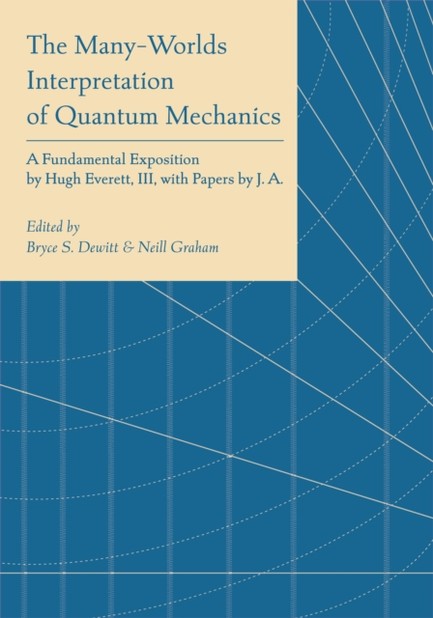
THE MANY-WORLDS INTERPRETATION OF QUANTUM MECHANICS
Εκδότης Princeton U.P. , ISBN 9780691273662
A landmark book on the influential many-worlds interpretation of quantum mechanicsIn 1957, Hugh Everett proposed a novel interpretation of quantum mechanics-a view that eventually became known as the many-worlds interpretation. This book presents Everett's two landmark papers on the idea-"'Relative State' Formulation of Quantum Mechanics" and "The Theory of the Universal Wave Function"-as well as further discussion of the idea in papers from a number of other physicists: J. A.
Wheeler, Bryce DeWitt, L. N. Cooper and D.Van Vechten, and Neill Graham. In his interpretation, Everett denies the existence of a separate classical realm and asserts the propriety of considering a state vector for the whole universe. Because this state vector never collapses, reality as a whole is rigorously deterministic.
This reality, which is described jointly by the dynamical variables and the state vector, isn't the reality customarily perceived; rather, it's a reality composed of many worlds. By virtue of the temporal development of the dynamical variables, the state vector decomposes naturally into orthogonal vectors, reflecting a continual splitting of the universe into a multitude of mutually unobservable but equally real worlds, in each of which every good measurement has yielded a definite result, and in most of which the familiar statistical quantum laws hold. Bryce S.
DeWitt (1923-2004) was a prize-winning theoretical physicist and professor emeritus of physics at the University of Texas at Austin. Neill Graham (1941-2015) was a physicist and writer.
Περίληψη
A landmark book on the influential many-worlds interpretation of quantum mechanicsIn 1957, Hugh Everett proposed a novel interpretation of quantum mechanics-a view that eventually became known as the many-worlds interpretation. This book presents Everett's two landmark papers on the idea-"'Relative State' Formulation of Quantum Mechanics" and "The Theory of the Universal Wave Function"-as well as further discussion of the idea in papers from a number of other physicists: J. A.
Wheeler, Bryce DeWitt, L. N. Cooper and D.Van Vechten, and Neill Graham. In his interpretation, Everett denies the existence of a separate classical realm and asserts the propriety of considering a state vector for the whole universe. Because this state vector never collapses, reality as a whole is rigorously deterministic.
This reality, which is described jointly by the dynamical variables and the state vector, isn't the reality customarily perceived; rather, it's a reality composed of many worlds. By virtue of the temporal development of the dynamical variables, the state vector decomposes naturally into orthogonal vectors, reflecting a continual splitting of the universe into a multitude of mutually unobservable but equally real worlds, in each of which every good measurement has yielded a definite result, and in most of which the familiar statistical quantum laws hold. Bryce S.
DeWitt (1923-2004) was a prize-winning theoretical physicist and professor emeritus of physics at the University of Texas at Austin. Neill Graham (1941-2015) was a physicist and writer.
Πληροφορίες προϊόντος
- Συγγραφέας Various Authors
- Eκδότης Princeton U.P.
- ISBN 9780691273662
- Κωδικός Ευριπίδη 040100092951
- Έτος κυκλοφορίας 2025
- Σελίδες 266
- Διαστάσεις 17χ25
- Βάρος 0 gr